
Category Archives: Strategic advocacy

“toxic mix of individualism and fear”

A couple of weeks ago our Saturday morning discussion group in the hospital cafeteria talked about how the lack of care and medical treatment for pain and addiction patients seems to stem from a lack of empathy rooted in a culture overemphasizing the “I’ at the expense of the “we.”

Came across the following that uses clear language to describe a parallel situation school children face:

Collini, Stefan. “Side by Side: On Britain’s School Wars.” The Nation, November 1, 2011.

Recent schools policy in Britain, like so much of current politics in Britain and the United States (and elsewhere), is founded on a toxic mix of individualism and fear. The fear is evident in the various metaphors of contamination that turn up in responses to any proposal that suggests the more advantaged may have to share life experiences with the less advantaged. Even parents who profess to believe in greater equality among adults want their children’s schooling to be protected against behavior associated with the lower orders. But the deforming perspective of individualism is more poisonous still—a refusal to place one’s experience and concerns in a larger social context, an indifference to the overall pattern, an obtuseness about the social determinants of behavior, a denial of the legitimate claims of others.


A Buddhist approach would talk about the illusion of the independent self, the consequences of attachment to that illusion, and the fearlessness arising when that attachment dissolves.
Insights from geology on incomplete information, uncertainty, and problem solving

Came across the following in the new issue of the Geological Society of America journal for members. A basic notion is that frequently a set of facts we know, or can know, are open to multiple interpretations, any or all of which might be true. When we come at a situation from multiple perspectives, each with its own set of facts, these taken together may set constraints that specify one true interpretation. The GSA article describes how that’s frequently the case in geology, And it goes further regarding uncertainty and incomplete knowledge in general. Seems that the following applies not only to geology and science, but should be included in the book and educational curriculum Roger Conner and I are writing on strategic policy advocacy:

Saltus, Richard W., and Richard J. Blakely. “Unique geologic insights from ‘non-unique’ gravity and magnetic interpretation.” GSA Today 21, no. 12 (December 2011): 4-10.

… Many of the greatest scientific challenges of today span the traditional subdivisions of science. Climate change research, for example, spans Earth, atmospheric,  and biological sciences and requires the combination of results from physics, chemistry, biology, geology, engineering, sociology, and economics. A key component to successful integrated science is the effective communication and mutual understanding of uncertainties arising in all of the component studies that feed into the ultimate integrated solution. But, it is also important to realize that the ultimate significance of a given result is not necessarily related to the relative certainty of that result. A partial solution or constraint to a fundamental problem may have greater significance than an exact solution to a trivial problem. And an effective integrated solution may encompass a wide range of uncertainties in the component results. To paraphrase Aristotle: The whole (integrated interpretation) is greater than the sum of its parts (methods and assumptions). And, we might add, the individual parts do not necessarily contribute equally to the sum. …

World People’s Conference on Climate Change and the Rights of Mother Earth: There is no conversation

Went through Google, Google News & the NY Times website looking for coverage and discussion of the climate conference recently hosted by Bolivia, the World People’s Conference on Climate Change and the Rights of Mother Earth.
See the  summary & comment by Naomi Klein in The Nation.

News of the conference  is essentially isolated to within progressive/left publications and blogs. No NY Times coverage. Didn’t find any discussion & debate about conference findings in sources with a point of view different from Morales and conference participants. The one mainline US media story I came across was in Time magazine, entitled “Bolivia’s Morales: Eating Chicken Makes You Gay?” with a link to “world’s worst-dressed leaders” ahead of any mention of climate issues.

I found out about the conference only because I read The Nation. Thank you Naomi Klein.

Note the combination of mainstream media control over information + interest groups talking only to themselves within publications and blogs that circulate among like-minded people, making engagement with the complexity of issues e.g. those raised at the conference almost impossible. There is no conversation.

The Dalai Lama’s martial artistry

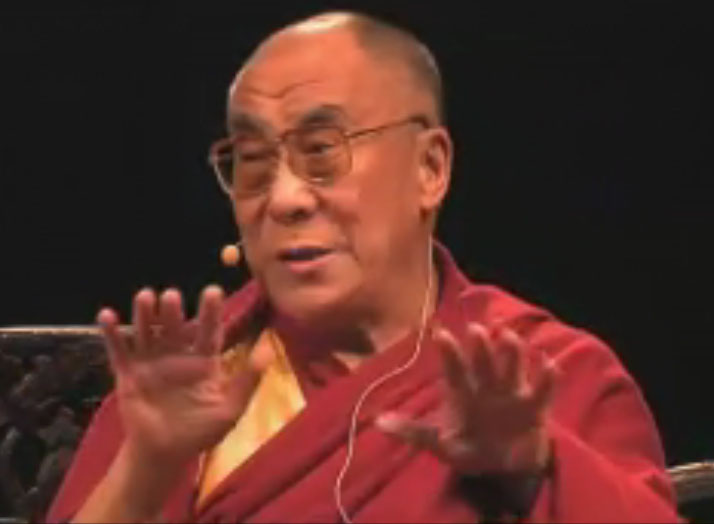
Seeing him for the first time, on the video of his talk on ethics at UC Santa Barbara, I was surprised, though perhaps should not have been, to find that the Dalai Lama moves with the presence of a trained martial artist or dancer. Watch his centered hand gestures. Through them he conveys a large part of his message. Where did he learn how to do that? It reflects long, physical practice. I found myself so absorbed in his gestures that at times I didn’t hear his words, and we had to replay them. For the Dalai Lama, physical as well as mental balance is essential for his effective public leadership.

Penetrating our most secure fortifications

Any genuine framework for effective action has to take into account the limits of rationality and go beyond them. How? Frank Rich’s column today points to the problem, but doesn’t provide answers:

[The White House party gate-crashing] was a symbolic indication (and, luckily, only symbolic) of how unbridled irrationality harnessed to sheer will, whether ludicrous in the crashers’ case or homicidal in the instance of the Fort Hood gunman, can penetrate even our most secure fortifications. Both incidents stand as a haunting reproach to the elegant powers of logic with which Obama tried to sell his exquisitely calibrated plan to vanquish Al Qaeda and its mad brethren.

Juxtapose this insight with the instability Tony Judt describes in his current NY Review of Books essay:

…Before 1914, it was widely asserted that the logic of peaceful economic exchange would triumph over national self-interest. No one expected all this to come to an abrupt end. But it did.

We too have lived through an era of stability, certainty, and the illusion of indefinite economic improvement. But all that is now behind us. For the foreseeable future we shall be as economically insecure as we are culturally uncertain. We are assuredly less confident of our collective purposes, our environmental well-being, or our personal safety than at any time since World War II. We have no idea what sort of world our children will inherit, but we can no longer delude ourselves into supposing that it must resemble our own in reassuring ways.

These indicate starting points for strategic thinking and effective action, and for personal decisions about how and when to engage with issues and events.

Consequences of choice of symbols: Framing and describing is more than an analytic tool

Framing and describing is more than an analytic tool. The words and concepts used are symbols that carry meanings, often multiple and easily unconscious, that have consequences and affect action. Writing the natural history of the Wrangell Mountains thus can have significant outcomes, beyond helping create a pleasant understanding of local geology and ecology for readers, and the choice of how to write it is significant: the selection of framing, concepts and terms and how they are presented, in what language, and visually as well, because the Wrangells are both a thing in itself and, at the same time, representative of something more. The same, of course, can be said about framing and description of any social or public issue. They are all political.

from Parks, S. D. “Leadership, Spirituality, and the College as a Mentoring Environment.” Journal of College and Character 10, no. 2 (2008), 5:

In Christian tradition, for instance, a dove is often used as a symbol for Spirit. In the Celtic experience of Christianity, however, a wild goose is often used as a symbol of Spirit. The symbols are similar, but they take us to different places. For example, a group of people was asked to think of the presence of Spirit as a dove, and then to consider how they should respond to a situation of injustice in inner-city housing. Their response tended to move in the direction of prayer and patience. Then they were asked to consider the same situation, thinking of Spirit as a wild goose. Their response then tended to move in the direction of mass protest at city hall!

State of the art reasoned analysis of complex social-economic systems

Kauffman is saying that the following sort of analysis is useful, in fact essential, but also inherently incomplete and insufficient:

From Ostrom, Elinor, Marco A Janssen, and John M Anderies. 2007. Going beyond panaceas. Proceedings of the National Academy of Sciences 104, no. 39: 15176-15178, p. 15178:

The study of the governance of SESs [social– ecological systems], and of sustainability science more generally, is an applied science like medicine and engineering, which aim to find solutions for diverse and complex problems. In diagnosing problems, the applied scientist examines attributes of a problem, layer by layer, and focuses on traits that are thought to be essential in a particular context. When an initial solution is adopted, considerable effort is made to dig deeply into the structure of the problem and to monitor various indicators of the system. On the basis of this information, applied scientists change their actions and learn from failures. The study of SESs, however, is not yet a mature applied science, but as the articles in this special feature attest, excellent research that can form the foundation for a mature applied science does exist.

Diagnosing the multiple processes occurring in complex, nested SESs is far more challenging than recommending a favorite cure-all solution to a simplified picture of all fisheries, all forests, or all terrestrial ecosystems. If sustainability science is to grow into a mature applied science, we must use the scientific knowledge acquired in the separate disciplines of anthropology, biology, ecology, economics, environmental sciences, geography, history, law, political science, psychology, and sociology to build diagnostic and analytical capabilities.

So, what sets of attitudes, skills, and experiences are appropriate for engaging with these problems, for being an effective, ethical actor and public leader? What practice, in the Buddhist sense? The answer calls for bringing together the analytic and the reasoned with the ethical and the poetic (are these the right terms?). We return to the question of the relationship between contemplation and action, of the ultimate and historical dimensions, of emotion and logic, heart and head, body and spirit, the necessity to become whole. This is expressed in the Shema, yes?

Why reasoned analysis is an insufficient foundation for effective action & leadership

In his Tillich lecture at Harvard this year, Stuart A . Kauffman says, “Reason is an insufficient guide to living our lives. … Therefore, we need all we’ve got. We need reason, emotion, intuition, imagination, story …” (Spoken at 48:20 minutes into the recording.)

From the press release for his Reinventing the Sacred: A new View of Science, Reason and Religion:

Kauffman asserts that it is time to break the Galilean spell – the faith that all aspects of the natural world are governed by natural laws – that has driven science for the past four centuries. With examples ranging from DNA and cell differentiation to Darwinian preadaptation, consciousness, and human technological advances, he argues that not everything that happens in the universe is governed by natural laws. The evolution of the biosphere, human economic life, and human history are partially indescribable by natural law, he writes.
Further, science alone simply doesn’t have the ability to predict the complex processes that occur every day. According to Kauffman, we do not lack sufficient knowledge or wisdom to predict the future evolution of the biosphere, economy, or human culture. Rather, it is that these things are inherently beyond prediction. We live in an emergent universe in which ceaseless unforeseeable creativity arises and surrounds us, writes Kauffman. And since we can neither prestate, let alone predict all that will happen, reason alone is an insufficient guide to living our lives forward.

“Sorting the relevant from the irrelevant, identifying salience, and directing decisions when uncertainty prevents definitive judgment.”

More support for bringing the Buddhist notion of “practice” into the practice of effective public leadership:

from Feleppa, Robert. 2009. Zen, Emotion and Social Engagement. Philosophy East & West 59, no. 3 (July): 263-293.

In the past two decades a number of researchers in psychology, cognitive science, and philosophy have converged on a different understanding of the place of the emotions in action, one which emphasizes the important role they play in framing the context of decision making: sorting the relevant from the irrelevant, identifying salience, and directing decisions when uncertainty prevents definitive judgment. I shall argue that this view of the more complex integration of reason and emotion makes clearer why self-liberation is fundamentally a matter of liberation from judgmental habit and inflexibility, and lends support to Hershock’s advocacy of a Mahâyâna view that emphasizes compassionate engagement with others.

Will be worth bringing in more of Lakoff’s take from the neurological/cognitive perspective, to see where it fits with the idea of liberation and the ethics of compassionate engagement.

Conze on perennial and sciential philosophies

The crux here is bringing the perennial and the sciential together, so they are both seen and experienced, though the distinctions are not blurred. Seems like the dichotomy is similar to (identical with?) the distinction between the ultimate and historical dimensions that Thich Nhat Hahn (Thây) refers to frequently. So Thây’s work would be a place to go to explore how the two fit together, and how to work with that connection and opposition. I am finding the question of the relationship between the perennial and sciential in both my activism (effective public leadership) and natural history projects. On the activism side, it’s expressed as the relationship between engagement with public issues to achieve specific policy goals, versus the potentially personally and socially transformative consequences of alternative methods of practice in this arena, in terms of our connections with the cosmos and beyond, with our mortality, and the ethical. On the natural history side, it’s the relationship between the geometric and quantitative scientific revolution, with its outfall, and nature as manifestation or representation of the ultimate. (See Rosenberg, previous post & his “The Revolution in Geology from the Renaissance to the Enlightenment.”) How to engage with both: a central question in my novel Alaska Dragon, so the question is basic, and the roots go deep.

from Conze, E. 1963. Buddhist Philosophy and Its European Parallels. Philosophy East and West 13, no. 1: 9–23, p. 14:
As  philosophies,  both   the  “perennial”   and  the “sciential”    systems  possess  some   degree   of intellectuality, and  up  to a point  they  both  use reasoning.  But considered  in their purity, as ideal types, they differ in that the first is  motivated by man’s spiritual needs, and aims at his salvation from the world  and its ways, whereas  the second  is motivated  by his utilitarian  needs, aims  at  his conquest  of  the  world, and  is  therefore  greatly concerned  with  the  natural  and  social  sciences. Between  the  two  extremes  there  are,  of  course, numerous  intermediary  stages.  They depend  to some extent  on the quality   of  the  spirituality behind them, which  is very high, say, in Buddhism, slightly lower in Plato and Aristotle, and still  quite marked in  such  men  as  Spinoza,  Leibniz, Berkeley, Kant, Goethe,  Hegel,  and  Bergson.   The  general  trend, however, has  been  a continuous  loss  of  spiritual substance   between   1450  and  1960,  based  on  an increasing  forgetfulness  of age-old  traditions, an increasing  unawareness of spiritual  practices, and an increasing indifference  to the spiritual life  by the classes which dominate society.

from Betty, L. S. 1971. The Buddhist-Humean Parallels: Postmortem. Philosophy East and West 21, no. 3: 237–253.

I agree with Professor Conze, along with practically all other students of Buddhism, that Buddhism, for the most part regardless of schools, provides “essentially a doctrine of salvation, and that all its philosophical statements are subordinate to its soteriological purpose.”