Harmony is dissonance being resolved into consonance. Pure consonance is not interesting, is not meaningful.
–Tom McIntire, Sensei at Nashville Aikido and trumpet teacher, in a conversation about tension and release in music, November, 2012.

Harmony is dissonance being resolved into consonance. Pure consonance is not interesting, is not meaningful.
–Tom McIntire, Sensei at Nashville Aikido and trumpet teacher, in a conversation about tension and release in music, November, 2012.
For his Vanderbilt Law School class on advocacy strategies, Roger Conner is having his students work on an event timeline describing the history of Tennessee’s state level health care reform effort, TennCare. It’s complicated. Following Kingdon, Roger segregates events into policy, political and problem streams. The problem stream has many numbers in various categories: how many people enrolled, annual costs, and the like. In the system Roger and I are developing to help advocates understand the situations they’re in, such a complicated story becomes the basis for further analysis using Elinor Ostrom, et al.’s IAD framework, which is complex in itself. For most people, it takes quite a bit of study of explanatory text to understand the basic IAD framework graphic:
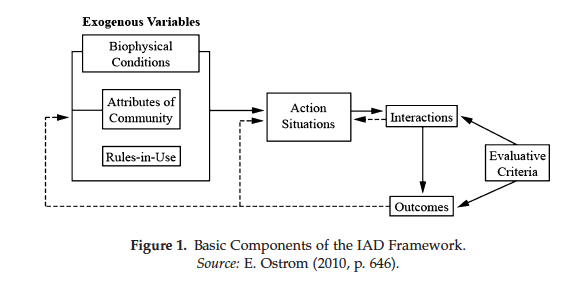
Activists working in the real world need to apply these concepts and relationships, and more, quickly and effectively. That means it must appear clear and straightforward to them. Figuring out how to teach this system and to provide the tools to use it is a big task for us.
Turns out that common elements in both our strategic advocacy project and my work in the Wrangell-St. Elias natural history project are timelines like this, that tell a complex history with multiple, interacting event streams. And in each, there’s the need to zoom in on details of shorter intervals within a long timespan. Conveying this information is a central challenge for my work overall, and I think for teaching and writing in both areas. This shared attribute of the advocacy and natural history projects is one indication of their similarity, too. The goal is clarity of vision in complex circumstances. Achieving that has moral, aesthetic and political and personal consequences.

Yaakov Garb and I talk about the “Van Andel” factor of any piece of written work. Tjeerd H. van Andel’s New Views on an Old Planet has long set the standard for us in clarity of presentation, both text and simple graphics. More recently, I’m appreciating Edward Tufte‘s masterful teachings on using layout and graphics to convey complex data. Yesterday, I enjoyed his Beautiful Evidence, which models great visual design as well as describing it. National Geographic’s large-format graphic displays, which it folds into its magazine, are another outstanding model.
I think it’ll be worth considerable effort to apply these models to explaining our strategic advocacy framework and to presenting the geological-ecological evolution of the Wrangell-St. Elias Mountains. For the Wrangells, I see working on getting the essence into a single large-format sheet, à la National Geographic. Perhaps the same could be the goal for the strategic advocacy framework. Whether or not the required combination of density and clarity of ideas is achievable in this form, its pursuit could help gain clarity of vision, which can also be pursued in other ways.
Here’s two versions of a photo taken looking back at Seattle from the Bainbridge ferry on my return from Alaska a few weeks ago: a reminder that urban landscapes can be as visually powerful as natural landscapes such as the Wrangell Mountains. Both urban and wild scenes embed infinite complex stories.
Take a look at the effects of subtle differences between these two versions. One is slightly compressed laterally, with some very slight perspective distortion. To me, that landscape is more inhumane, impersonal and alienating than the version which has objectively correct proportions. I presume that our brains are always modifying perceptions, perhaps similar to what can be done in Photoshop, to adjust what we see to fit preconceptions, hopes and fears. If I believe the city is alienating, do I see it visually consistent with and re-enforcing of that belief? What can be accomplished by training the mind to be aware of perception biases and able to consciously alter them?


From Eric Alterman’s April 30 Nation column, “The Fight for American Liberalism,” emphasis and notes added:
Liberal politics, Michael Walzer observes, is difficult “because it offers so few emotional rewards…it lacks warmth and intimacy.” Without universal foundations—Lionel Trilling termed it “a large tendency rather than a concise body of doctrine”—liberalism can offer only narratives of sacrifice and common purpose, ones that can often be trumped by the tales of the right …
[See Walzer, Michael. Radical Principles: Reflections of an Unreconstructed Democrat. Basic Books, 1980, 69,68: “A liberal nation can have no collective purpose …. Liberalism, even at its most permissive, is a hard politics because it offers to few emotional rewards; the liberal state is not a home for its citizens; it lacks warmth and intimacy.”]
[See Townsley, Jeremy. “Walzer, Citizenship, Globalization and Global Public Goods,” citing Veit Bader, “Citizenship and Exclusion: Radical Democracy, Community, and Justice. Or, what is Wrong with Communitarianism?”Political Theory 23 (1995): 218: “…neighborhoods, clubs and families … are ‘warm, horizontal [communities] … based on consent’ whereas states are ‘cold vertical institutions, based not on free entry but on enforced membership and physical violence. Strictly speaking, [states] are not associations at all, but institutions.'”]
… To be a “liberal” is to be a child of the Enlightenment… Liberalism insists that individuals take hold of their fate and shape it …
… If both [FDR and Reagan] met with mixed success in policy terms, both nevertheless were able to reshape political culture because the optimism and self-confidence of the visions they offered captured the imagination of a majority of Americans, particularly the young.
If their fortunes are ever to revive, liberals must find a way to recapture this simultaneously militant and optimistic spirit. The “larger message” for what Roosevelt called “the liberal party” was a clear and simple one: “As new conditions and problems arise beyond the power of men and women to meet as individuals, it becomes the duty of the Government itself to find new remedies with which to meet them.” Add to this John Dewey’s precept that “government should regularly intervene to help equalize conditions between the wealthy and the poor, between the overprivileged and the underprivileged,” while acknowledging Reinhold Niebuhr’s prescient call for “humility” in all such undertakings, and you have a concise, compelling statement of what it means—then as now—to call oneself an “American liberal.”
When liberals lose confidence in their ability to lead Americans toward the fulfillment of this vision, they lose their reason for being liberals. If the history of liberalism has a single lesson to teach us, it is that what liberals have to fear most—far more than conservatives—is fear itself.
So, the cold state is to provide what the individual cannot? Where do the real downsides of government fit in here? A return to the FDR past is insufficient/unrealistic, and doesn’t acknowledge the truths of conservative views.
In terms of the basic principles Roger Conner and I are developing for looking at political situations: in evaluating Alterman’s presentation, and evaluating the liberal vision, a key step is seeing them from opposing/different perspectives, starting with the assumption these other views are valid.
A couple of weeks ago our Saturday morning discussion group in the hospital cafeteria talked about how the lack of care and medical treatment for pain and addiction patients seems to stem from a lack of empathy rooted in a culture overemphasizing the “I’ at the expense of the “we.”
Came across the following that uses clear language to describe a parallel situation school children face:
Collini, Stefan. “Side by Side: On Britain’s School Wars.” The Nation, November 1, 2011.
Recent schools policy in Britain, like so much of current politics in Britain and the United States (and elsewhere), is founded on a toxic mix of individualism and fear. The fear is evident in the various metaphors of contamination that turn up in responses to any proposal that suggests the more advantaged may have to share life experiences with the less advantaged. Even parents who profess to believe in greater equality among adults want their children’s schooling to be protected against behavior associated with the lower orders. But the deforming perspective of individualism is more poisonous still—a refusal to place one’s experience and concerns in a larger social context, an indifference to the overall pattern, an obtuseness about the social determinants of behavior, a denial of the legitimate claims of others.
A Buddhist approach would talk about the illusion of the independent self, the consequences of attachment to that illusion, and the fearlessness arising when that attachment dissolves.
… Many of the greatest scientific challenges of today span the traditional subdivisions of science. Climate change research, for example, spans Earth, atmospheric, and biological sciences and requires the combination of results from physics, chemistry, biology, geology, engineering, sociology, and economics. A key component to successful integrated science is the effective communication and mutual understanding of uncertainties arising in all of the component studies that feed into the ultimate integrated solution. But, it is also important to realize that the ultimate significance of a given result is not necessarily related to the relative certainty of that result. A partial solution or constraint to a fundamental problem may have greater significance than an exact solution to a trivial problem. And an effective integrated solution may encompass a wide range of uncertainties in the component results. To paraphrase Aristotle: The whole (integrated interpretation) is greater than the sum of its parts (methods and assumptions). And, we might add, the individual parts do not necessarily contribute equally to the sum. …
 Emma Marris’s new book Rambunctious Garden is some of the best stuff I’ve seen on today’s wildness/wilderness issues. She critiques the notion of a “baseline” ideal for a landscape, e.g. pre-Euroamerican for Yellowstone or 1938 for Kennecott, Alaska. Her work is limited to nature & ecosystems, rather than human history as in McCarthy-Kennecott, but I think the same ideas apply and could be extended to fit.
Her writing explains just where the National Park Service is coming from re both its natural area and historic site management founded on the baseline ideal, and shreds it.
From what I’ve read so far (only part way through the book), I think she is overconfident about the potential for well planned management to provide solutions and is insufficiently unaware of its downsides. Similar to the way complexities and ambiguities render the baseline ideal landscape undefinable and unattainable, complexities and uncertainties limit the role of environmental management (a term which my mentor Grant McConnell used to spit out with disdain).
Further steps developing from Marris’s work so far could include expanding it to the social/cultural and putting her critique of the baseline ideal together with a critique of planned management. The two critiques make a good pair. Would be very interesting to do that and see what develops from it.
Marris, Emma. Rambunctious Garden: Saving Nature in a Post-Wild World. 1st ed. New York, NY: Bloomsbury USA, 2011.
audio interview with Emma Marris at http://www.wpr.org/hereonearth/archive_110901k.cfm
From a draft manuscript by our friend Dr. Kimber Rotchford:
Addictions are our human tendencies to be neurotic taken one step further into the realm of brain disease.
So, attachment, in the Buddhist sense, is psychological and social fixation on desire (neurotic), but is also physiological, in that it is physically embodied, including but not limited to in the brain. The brain is altered by the process. At some point this physiological alteration becomes sufficient for it to be called a brain disease. That then, in Kimber’s perspective as I understand it, is the point where it is designated as addiction. Some addictions involve irreversible physiological changes and thus require ongoing drug treatment to maintain functional brain chemistry.
Notice here that all attachment, all fixated desire, has a physical element. When of character and degree to be signficantly disfunctional (by some standard), then it is a disease, like other physical diseases.
from Shultziner, D., T. Stevens, M. Stevens, B. A Stewart, R. J Hannagan, and G. Saltini-Semerari. “The causes and scope of political egalitarianism during the Last Glacial: a multi-disciplinary perspective.” Biology and Philosophy 25 (2010): 319-346.
…For the development of hierarchical social structures, for example, social factors are essential but not sufficient—high degrees of resource abundance and stability are also essential. …
By similar logic, scarcity and instability break down hierarchical social structures, e.g. Somalia today, etc. What you get now is a return to small social units adapting to instability & scarcity, but in a situation of crowding and access to modern weaponry, rather than Pleistocene conditions.
Went through Google, Google News & the NY Times website looking for coverage and discussion of the climate conference recently hosted by Bolivia, the World People’s Conference on Climate Change and the Rights of Mother Earth.
See the summary & comment by Naomi Klein in The Nation.
News of the conference is essentially isolated to within progressive/left publications and blogs. No NY Times coverage. Didn’t find any discussion & debate about conference findings in sources with a point of view different from Morales and conference participants. The one mainline US media story I came across was in Time magazine, entitled “Bolivia’s Morales: Eating Chicken Makes You Gay?” with a link to “world’s worst-dressed leaders” ahead of any mention of climate issues.
I found out about the conference only because I read The Nation. Thank you Naomi Klein.
Note the combination of mainstream media control over information + interest groups talking only to themselves within publications and blogs that circulate among like-minded people, making engagement with the complexity of issues e.g. those raised at the conference almost impossible. There is no conversation.
 Living on Unstable Ground