
Economics is often defined as the study of the allocation of scarce resources. But “scarcity” doesn’t simply exist: it is produced by the interaction of our wanting and what exists or is produced, viz. the interaction of demand and supply. Hence, the fundamental economic problem is the management of the tension between what is produced and our desiring, our wanting. At the core of the study of economics and the systems that arise from it is an inquiry into the nature of our wanting.
Category Archives: Complexity
Harmony is dissonance being resolved
Harmony is dissonance being resolved into consonance. Pure consonance is not interesting, is not meaningful.
–Tom McIntire, Sensei at Nashville Aikido and trumpet teacher, in a conversation about tension and release in music, November, 2012.
Graphic display of complex information: A challenge for both the strategic advocacy and natural history projects
For his Vanderbilt Law School class on advocacy strategies, Roger Conner is having his students work on an event timeline describing the history of Tennessee’s state level health care reform effort, TennCare. It’s complicated. Following Kingdon, Roger segregates events into policy, political and problem streams. The problem stream has many numbers in various categories: how many people enrolled, annual costs, and the like. In the system Roger and I are developing to help advocates understand the situations they’re in, such a complicated story becomes the basis for further analysis using Elinor Ostrom, et al.’s IAD framework, which is complex in itself. For most people, it takes quite a bit of study of explanatory text to understand the basic IAD framework graphic:
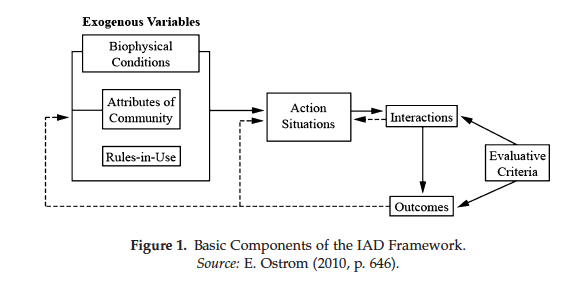
Activists working in the real world need to apply these concepts and relationships, and more, quickly and effectively. That means it must appear clear and straightforward to them. Figuring out how to teach this system and to provide the tools to use it is a big task for us.
Turns out that common elements in both our strategic advocacy project and my work in the Wrangell-St. Elias natural history project are timelines like this, that tell a complex history with multiple, interacting event streams. And in each, there’s the need to zoom in on details of shorter intervals within a long timespan. Conveying this information is a central challenge for my work overall, and I think for teaching and writing in both areas. This shared attribute of the advocacy and natural history projects is one indication of their similarity, too. The goal is clarity of vision in complex circumstances. Achieving that has moral, aesthetic and political and personal consequences.

Yaakov Garb and I talk about the “Van Andel” factor of any piece of written work. Tjeerd H. van Andel’s New Views on an Old Planet has long set the standard for us in clarity of presentation, both text and simple graphics. More recently, I’m appreciating Edward Tufte‘s masterful teachings on using layout and graphics to convey complex data. Yesterday, I enjoyed his Beautiful Evidence, which models great visual design as well as describing it. National Geographic’s large-format graphic displays, which it folds into its magazine, are another outstanding model.
I think it’ll be worth considerable effort to apply these models to explaining our strategic advocacy framework and to presenting the geological-ecological evolution of the Wrangell-St. Elias Mountains. For the Wrangells, I see working on getting the essence into a single large-format sheet, à la National Geographic. Perhaps the same could be the goal for the strategic advocacy framework. Whether or not the required combination of density and clarity of ideas is achievable in this form, its pursuit could help gain clarity of vision, which can also be pursued in other ways.
Visually powerful landscapes: Seattle waterfront & skyline
Here’s two versions of a photo taken looking back at Seattle from the Bainbridge ferry on my return from Alaska a few weeks ago: a reminder that urban landscapes can be as visually powerful as natural landscapes such as the Wrangell Mountains. Both urban and wild scenes embed infinite complex stories.
Take a look at the effects of subtle differences between these two versions. One is slightly compressed laterally, with some very slight perspective distortion. To me, that landscape is more inhumane, impersonal and alienating than the version which has objectively correct proportions. I presume that our brains are always modifying perceptions, perhaps similar to what can be done in Photoshop, to adjust what we see to fit preconceptions, hopes and fears. If I believe the city is alienating, do I see it visually consistent with and re-enforcing of that belief? What can be accomplished by training the mind to be aware of perception biases and able to consciously alter them?


Insights from geology on incomplete information, uncertainty, and problem solving
Came across the following in the new issue of the Geological Society of America journal for members. A basic notion is that frequently a set of facts we know, or can know, are open to multiple interpretations, any or all of which might be true. When we come at a situation from multiple perspectives, each with its own set of facts, these taken together may set constraints that specify one true interpretation. The GSA article describes how that’s frequently the case in geology, And it goes further regarding uncertainty and incomplete knowledge in general. Seems that the following applies not only to geology and science, but should be included in the book and educational curriculum Roger Conner and I are writing on strategic policy advocacy:
… Many of the greatest scientific challenges of today span the traditional subdivisions of science. Climate change research, for example, spans Earth, atmospheric, and biological sciences and requires the combination of results from physics, chemistry, biology, geology, engineering, sociology, and economics. A key component to successful integrated science is the effective communication and mutual understanding of uncertainties arising in all of the component studies that feed into the ultimate integrated solution. But, it is also important to realize that the ultimate significance of a given result is not necessarily related to the relative certainty of that result. A partial solution or constraint to a fundamental problem may have greater significance than an exact solution to a trivial problem. And an effective integrated solution may encompass a wide range of uncertainties in the component results. To paraphrase Aristotle: The whole (integrated interpretation) is greater than the sum of its parts (methods and assumptions). And, we might add, the individual parts do not necessarily contribute equally to the sum. …
Scarcity and instability break down hierarchical social structures
from Shultziner, D., T. Stevens, M. Stevens, B. A Stewart, R. J Hannagan, and G. Saltini-Semerari. “The causes and scope of political egalitarianism during the Last Glacial: a multi-disciplinary perspective.” Biology and Philosophy 25 (2010): 319-346.
…For the development of hierarchical social structures, for example, social factors are essential but not sufficient—high degrees of resource abundance and stability are also essential. …
By similar logic, scarcity and instability break down hierarchical social structures, e.g. Somalia today, etc. What you get now is a return to small social units adapting to instability & scarcity, but in a situation of crowding and access to modern weaponry, rather than Pleistocene conditions.
 Living on Unstable Ground