All posts by Ben Shaine

Risk landscapes

Reading

which looks at the risk of spotted owl extinction in landscapes of various patterns, including evaluation of mathematical landscape models used for that purpose:

Leads me to the notion of “risk landscape”  —
To what extent can understanding the physical landscapes of the owl forest, and the mathematically modeled landscapes developed to approximate them, be useful in seeing other risk situations as metaphorical landscapes, e.g. medical treatment decisions or political strategy decisions. If so, then terms like “paths” through these metaphorical landscapes could apply, and factors could be added to the model equivalent to climate in physical landscapes, the adaptability characteristics of the traveler through the landscape, etc.
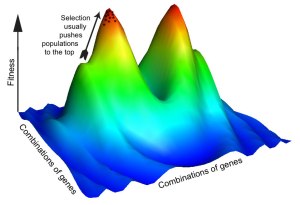
diagram of an adaptive landscapeEcologists have used “fitness landscapes” to visualize how natural selection brings populations to optimal points. (See also, e.g.,  Chris Colby 1996.) I wonder how much further the landscape metaphor can be expanded to other uses.

But also perhaps flip this around:
Taking it another step, is it (or to what extent is it) that what we perceive as physical landscape is our human way of modeling incoming information or data. In other words, could it be that the physical landscape, as we know it, is a model that we create to make useful sense of the incomplete, diverse, complex information that comes into us, and that we combine with what’s inside of us already? The physical landscape, the physical world, as we understand it, is in that sense a human construction. Worth remembering that all models are simplifications, usually created to be useful for specific purposes.

What is the reality beyond the model? Is there a way of accessing that, other than through other models? Religious answers beyond modeling include faith, and practice.
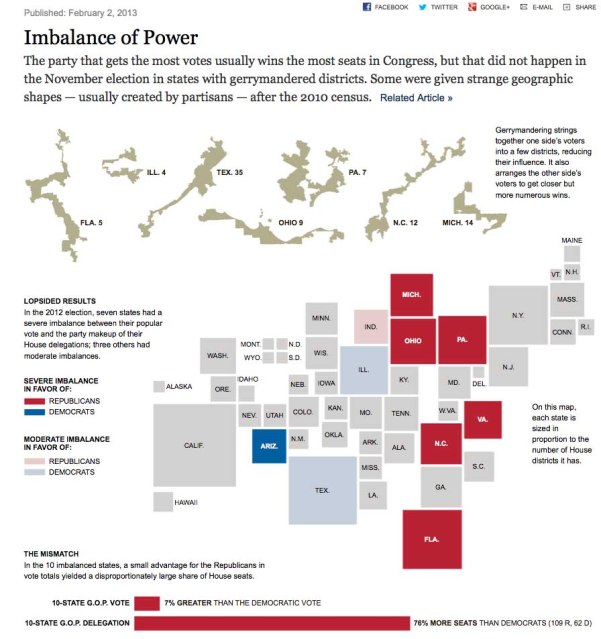
Effective graphics: Congressional gerrymandering

There’s a lot of news & commentary about US congressional gerrymandering, with arguments back and forth about its cause and effect, which have led me to no certain conclusion. This one graphic cuts through all that with what looks like a definitive answer, simply understood and convincing.

It’s done with a sequence of three graphics, each of a different type suited to what is being conveyed,  with a one-sentence explanation accompanying each.

New York Times effective graphic explaining congressional gerrymandering

Earlham’s core principles of wilderness education: Living in a “positive state of non-expectancy”

Strikingly similar to the values of the Wrangell Mountains Center —

Core principles guiding the Earlham College wilderness program educational mission:

  • The Adventuresome Spirit
    Viewing obstacles as challenges to be overcome. Actively seeking out opportunities to learn and to push oneself outside the “comfort zone.” Living life in a “positive state of non-expectancy” — allowing for appreciation of the trail magic that can come from being present and aware of the adventuresome potential of each moment.
  • Sense of Place
    A connection to the land we are traveling through such that we are not just tourists or passersby but, rather, we become changed by our relationship with the land and its stories. As modern life increasingly separates us from such relationships, the principle of gaining a “sense of place” on wilderness trips reminds us that this value is critical toward the creation of a personal and a larger community-based environmental ethic.
  • Servant Leadership
    Servant leadership is defined as the ability to think of others through the acquired skills of listening, observation, awareness, empathy, acceptance and foresight. It is the difference between caring “about” something or someone and “caring for” it. It is an active behavior that happens in lots of little ways. A servant leader constantly thinks about how to help his or her group in small and big ways. A servant leader is also aware of “giving back” in small and big ways to the people and the places he or she experiences. Finally, a servant leader understands that knowledge and experiences acquired have moral consequences and leaves changed as well as committed to working toward putting that change into service.
  • The Contemplative Spirit
    Kurt Hahn, the founder of Outward Bound and one of the central figures in the field of outdoor and experiential education created the 7 Laws of Salem which were his goals for operating his first school in England. One of his 7 laws was to “provide periods of silence, following the great precedent of the Quakers. Unless the present day generation acquires early habits of quiet and reflection, it will be speedily and prematurely used up by the nerve-exhausting and distracting civilization of today.” Hahn wrote that in the 1920’s. The art of contemplation and reflection is what brings meaning to our lives. It is also fundamental to the kind of deep and rigorous observation and scholarship we value at Earlham. On course, there will be many opportunities to practice the contemplative spirit.There will be “small” moments, for example, it is common to begin major meals with a moment of silence. There will also be “larger” ones like silent paddles and hikes, reflective solo’s, and observation activities.
  • Simplicity
    Simplicity and simple living is comprised of two parts: inward simplicity and outward simplicity. The two are, of course, connected. Inward simplicity can be defined by the priorities and goals that you have in your life and how you make decisions about them. Outward simplicity is how you manifest those priorities and goals to the world. Wilderness courses are all about simple living- both inwardly and outwardly. You carry everything you need on your back or in your canoe. You eat simply but heartily. You will have a minimum of possessions and “modern” distractions. This outward simplicity, we hope, will encourage inward simplicity- allowing you to reflect on what is truly important to you and how you want to go about “walking joyfully on this earth” as George Fox, founder of the Religious Society of Friends” once famously said.

Deconstruction of self-existence allows “something else” to shine forth

From the Introduction, page 4, by David Loy in his edited collection Healing Deconstruction: Postmodern Thought in Buddhism and Christianity:

According to Madhyamika, our taken-for-granted world is mentally-constructed by our delusive attribution of self-existence to objects, which makes us experience that world as a collection of discrete things interacting in space and time; and that leads to suffering insofar as we understand ourselves to be such self-existing things, who are nonetheless subject to the ravages of time and change–who are born only to fall ill, grow old, and die. Merely by subverting such ontological claims, and without offering any views of its own, the Buddhist deconstruction of such self-existence (especially our own) can allow “something else” to shine forth.

In my recent training experience, I have the sense that Aikido is physically deconstructing my perception of an independently-acting self.

Several close friends believe we have immortal souls. Not sharing that faith makes Marci’s impending death more lonely for me, a forever loss. Far from belief in a discrete immortal soul that does not die, the Madhyamika Buddhist view is that we don’t have that individuality, even in this life. But it seems to be a view into a bigger space.

SunyataThere are now brief moments of doing it right in my otherwise relatively unskilled Aikido practice, when, with no push and no pull, I move someone much bigger than myself — it happens, not often! It is without effort, but by congruence. Something else shines forth?

Breaking balance

From a conversation with Hiroshi Ikeda Sensei at his Aikido dojo in Boulder in December:

To gain control by breaking balance:

  1. Establish connection.
  2. Through attention to partner’s structure, move one point, even a little bit, to establish motion.
  3. Then creativity is possible.

All of this done relaxed, with no force or anger.

Core of economics is inquiry into the nature of wanting

Economics is often defined as the study of the allocation of scarce resources. But “scarcity” doesn’t simply exist: it is produced by the interaction of our wanting and what exists or is produced, viz. the interaction of demand and supply. Hence, the fundamental economic problem is the management of the tension between what is produced and our desiring, our wanting. At the core of the study of economics and the systems that arise from it is an inquiry into the nature of our wanting.

The spiritual is the study of reality: Aikido seminar with William Gleason and George Ledyard

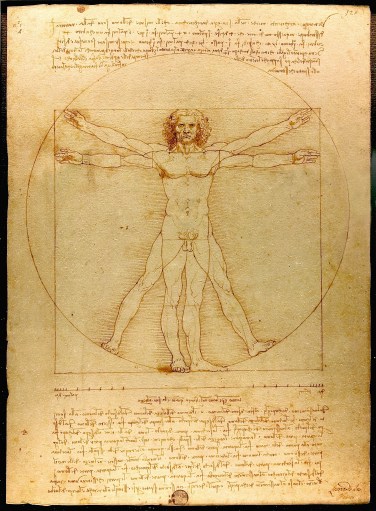
Da_Vinci_Vitruve_Luc_Viatour
Leonardo da Vinci, Vitruvian Man, 1487
“Leonardo envisaged the great picture chart of the human body he had produced through his anatomical drawings and Vitruvian Man as a cosmografia del minor mondo (cosmography of the microcosm). He believed the workings of the human body to be an analogy for the workings of the universe.”

From the seminar at Aikido Eastside, Bellevue, January 4-6, 2013:

What is spiritual, but the study of reality.

–William Gleason Sensei

George Ledyard Sensei’s instructions:

  • Get yourself organized.
  • Make connection.
  • Do not be attached to the result.

I think:

  • “Get yourself organized” means conforming with the logos.
  • “Not being attached to the result” means not being habituated or addicted.line shortFrom lunch discussion with Sensei Gleason, Sensei Ledyard, et al.:
  • The vector to mastery is the spiritual quest.
  • Being on the vector to mastery makes endeavor worthwhile.
  • A teacher need not have achieved mastery to be worthwhile. But the difference between a worthwhile practice and a mediocre one is whether the channel is open in the direction of mastery, regardless of how far progress has been achieved.

Brion Toss, weapons sensei at Aikido Port Townsend, and I wondered about how you know whether you are on a path to mastery or are fooling yourself. I suspect that reality, action in the real world, provides the answer. As we experience on the mat, only good technique works, provided that the attack (the encounter) is genuine. If it doesn’t work, you know, because you fail. Reality, the organizing principle, the logos, provides the constraints that create the form of the practice and its evolution. It’s possible to be screened from reality by habits, fantasies and addictions — frequently happens. You can live in that undisciplined world so long as it is self-contained, does not contact with reality. Then reality penetrates with overwhelming power.

From previous Gleason Sensei seminars at Aikido Eastside: